HP vs Lenovo: Which Laptop Brand Is Better in 2026?
Disclosure: This post contains affiliate links. We earn a commission on purchases made through these links, at no extra cost to you.
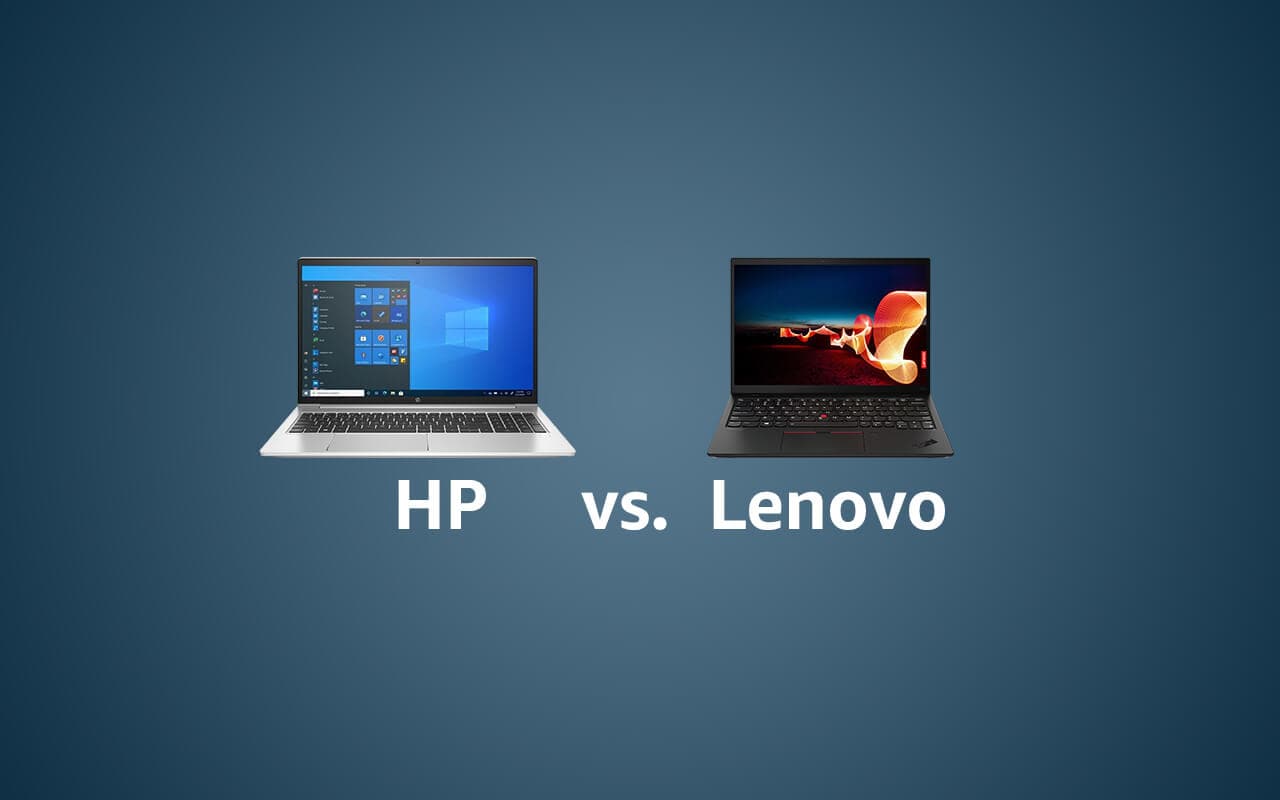
Neither HP nor Lenovo is the "better" brand overall — it depends on what you're buying and why. For everyday use and value, both are close; Lenovo generally has an edge in budget-to-midrange pricing and business laptops (ThinkPad), while HP tends to win on premium consumer design (OmniBook, formerly Spectre/Envy) and creator-friendly displays. For gaming, Lenovo's Legion lineup is the more consistently well-reviewed choice over HP's HyperX OMEN and Victus. Read on for the specifics that actually matter for your use case.
HP vs Lenovo at a glance
| HP | Lenovo | |
|---|---|---|
| Best known for | Consumer design, business EliteBook/ProBook line, printers | ThinkPad business laptops, budget-to-midrange value, #1 global PC maker |
| Founded | 1939 (HP Inc. split from Hewlett Packard Enterprise in 2015) | 1984 in Beijing (as Legend); acquired IBM's PC division, including ThinkPad, in 2005 |
| Consumer lineup | OmniBook Ultra, OmniBook X, OmniBook 5/3 | Yoga, IdeaPad (1/3/5/7) |
| Business lineup | ProBook 4 → EliteBook 6/8 → EliteBook X | ThinkBook, ThinkPad (E/L/T/X/P series, X9 Aura Edition) |
| Gaming lineup | HyperX OMEN (premium), Victus (budget) | Legion (5/7/9, Slim), LOQ (budget) |
| Typical starting price | ~$400–500 for entry consumer models | ~$350–450 for entry consumer models |
| Business security suite | HP Wolf Security | Lenovo ThinkShield |
| Standard warranty | 1 year | 1 year |
| Global PC market share (Q1 2026, IDC) | ~18.5% (#2) | ~25.2% (#1) |
| Headquarters | Palo Alto, California | Beijing, China / Morrisville, North Carolina (dual HQ) |
Lineups explained: old names vs new names
HP overhauled its consumer naming in May 2024 as part of a broader rebrand, so if you've shopped HP before and the names look unfamiliar now, that's why:
- Spectre → OmniBook Ultra (flagship premium)
- Envy → OmniBook X (premium mainstream)
- Pavilion → OmniBook 5 / OmniBook 3 (mainstream/entry)
- Dragonfly → EliteBook X (premium business)
- ProBook survives as HP's entry-level commercial tier (currently ProBook 4 G2)
HP's 2026 business ladder runs ProBook 4 → EliteBook 6 → EliteBook 8 → EliteBook X, low to high. In HP's naming, odd numbers generally mean consumer-facing, even numbers mean commercial, "X" marks the higher-end tier, and "Ultra" is reserved for the flagship. A trailing G2i/G2a/G2q denotes the chip platform (Intel/AMD/Qualcomm). On the gaming side, HP folded its OMEN brand under HyperX at CES 2026, so it's now marketed as "HyperX OMEN"; Victus continues as the budget gaming line.
Lenovo's structure has stayed more stable, though it's added an "Aura Edition" tier — a Lenovo-and-Intel co-engineered premium spec level (better chassis, cooling, and AI-feature tuning) that now sits atop flagship models like the ThinkPad X1 Carbon Gen 14 and Yoga Pro 9i. Current Lenovo lines:
- ThinkPad — business/pro, with X (ultraportable, e.g. X1 Carbon, X9 Aura Edition), T and L (mainstream business), E (entry business), and P (mobile workstation) series
- ThinkBook — a newer "prosumer" business line: consumer-grade looks with business-grade support
- IdeaPad — everyday consumer, roughly tiered 1/3 (budget), 5 (midrange), 7 (top consumer)
- Yoga — premium consumer 2-in-1s and creator laptops
- Legion — gaming, from Legion Slim up through Legion 5/7/9
- LOQ — budget gaming, launched in 2023 as Legion's cheaper sibling
If you want the deeper breakdown of either brand's current models, see our full HP laptop series guide and Lenovo laptop series guide.
Price & value
At the low end, both brands price entry consumer laptops in a similar band, typically around $350–500, and neither is reliably cheaper across the board — it swings model to model and by sale timing. Lenovo has historically had a slight edge on budget-to-midrange value (IdeaPad and LOQ pricing tends to undercut HP's equivalent OmniBook 3/Victus models), while HP has generally priced its premium OmniBook Ultra and EliteBook X lines competitively against Lenovo's Yoga and ThinkPad X1 lines rather than cheaper. Bottom line: if price is your main filter, compare the specific models you're considering rather than assuming either brand as a whole is cheaper — check current listings for the HP OmniBook lineup and Lenovo IdeaPad lineup.
Build quality & reliability
Brand-wide reliability data is genuinely thin — Rescuecom, the source most "most reliable laptop brand" articles cite, hasn't published a new report since 2020 (Lenovo placed second behind Microsoft that year). Nothing more recent shows a decisive, well-evidenced gap between HP and Lenovo at the brand level.
What actually predicts durability is the line, not the brand. ThinkPads and EliteBooks are built to a genuinely tougher spec (MIL-STD-810H testing, magnesium-alloy or carbon-fiber chassis on the higher tiers) than IdeaPad or OmniBook 3 machines, which use lighter, more cost-driven plastics. So "is HP or Lenovo more reliable" is the wrong question — "is a ThinkPad more durable than an IdeaPad" is the right one, and the answer there is clearly yes.
One myth worth killing: you'll still see claims online that HP laptop parts are "universal" and interchangeable across models. They aren't — parts are model- and even configuration-specific, same as any other manufacturer. Both companies publish official parts lookup tools (HP PartSurfer, Lenovo's parts lookup portal) and service documentation, so repairs are broadly comparable in difficulty; neither brand is meaningfully more repairable than the other in the way a Framework laptop is.
Keyboards & everyday use
This is where Lenovo has a genuine, long-standing reputation edge: ThinkPad keyboards are widely regarded as some of the best in the industry, with deep, well-damped key travel that's held up across decades of redesigns (the signature red TrackPoint nub is still there too). HP's keyboards on OmniBook and EliteBook models are solid and comfortable but don't carry the same cult following.
For everyday portability and display quality, it's more of a wash — both brands put good OLED or high-nit IPS panels on their premium lines (OmniBook Ultra, Yoga, ThinkPad X1) and cut corners similarly on entry models.
Gaming: Legion vs HyperX OMEN & Victus
Lenovo's Legion line is the more consistently well-reviewed gaming lineup. Legion laptops (5/7/9, plus the budget-friendly Legion Slim) are regularly praised for cooling performance and price-to-performance, and Lenovo's LOQ series undercuts most budget gaming competition on price while still delivering current-gen RTX GPUs.
On HP's side, the gaming brand structure changed in January 2026: OMEN was folded under HyperX, so HP's premium gaming laptops are now sold as "HyperX OMEN," while Victus remains the budget tier. HyperX OMEN models are competitive on specs and cooling, but Victus is generally the better value pick if you're gaming casually or splitting time between games and everyday work.
If gaming performance is your top priority and you don't have brand loyalty either way, Legion is the safer default recommendation based on current reviews; if you're already committed to HP's ecosystem or want a budget laptop that games acceptably, Victus is worth a look.
Business & security
Both brands run serious enterprise security stacks, and neither is "more secure" in a way that matters for typical buyers — the differences are in approach:
- HP Wolf Security (on EliteBook, ProBook, and ZBook) includes self-healing BIOS protection (HP Sure Start), runtime process protection (Sure Run), and network-based OS recovery (Sure Recover). HP introduced HP TPM Guard in 2026, aimed at blocking physical TPM-bus attacks that can defeat drive encryption.
- Lenovo ThinkShield covers similar ground — BIOS-level protection, runtime protection against tampering, and certificate-based (rather than password-only) authentication options.
For most home and small-business buyers this is overkill either way; it matters more if you're outfitting a fleet through IT.
Support & warranty
Standard warranty coverage is one year on both brands for most consumer models, and both offer paid extended coverage — HP Care Packs and Lenovo Premium Care/Premium Care Plus — that can stretch protection out several years and add accidental damage coverage. Neither brand has a meaningfully better default warranty; the difference is in what you're willing to pay for extended plans, and those prices vary by model, so check the specific configuration you're buying rather than assuming a flat rate.
Which should you buy?
Budget buyers: Lean Lenovo. IdeaPad and LOQ consistently give more for the money at entry price points than HP's OmniBook 3 and Victus equivalents, though it's worth cross-shopping both before buying.
Business buyers: ThinkPad is the stronger default if keyboard quality and long-term durability matter most to you; EliteBook (and EliteBook X) is a very close alternative, especially if your organization already standardizes on HP Wolf Security or HP's IT management tools.
Gamers: Legion, for most people — it's the more consistently reviewed gaming line right now. HyperX OMEN is a fine alternative if you prefer HP's ecosystem or design language. In the budget tier, LOQ usually wins on raw price-to-performance, while Victus is worth cross-shopping when it's on sale — both rotate through heavy discounts.
Students: Either brand's entry consumer line (IdeaPad 3/5 or OmniBook 3) will handle typical coursework fine — pick based on price and the specific configuration on sale, not the badge.
2-in-1 / convertible buyers: Lenovo's Yoga and HP's OmniBook X (formerly Envy) convertibles are closely matched; compare screen quality and hinge feel in person or via reviews of the exact model, since this category varies a lot generation to generation.
If you're deciding between HP and a third brand instead, our ASUS vs HP comparison covers that matchup, and our breakdown of whether HP laptops are actually good digs deeper into HP specifically.
Frequently asked questions
Are HP and Lenovo the same company? No. They're separate, independently owned companies and direct competitors. HP Inc. is a US company headquartered in Palo Alto, California; Lenovo is a Chinese company headquartered jointly in Beijing and Morrisville, North Carolina. They've never merged or shared ownership.
Is Lenovo a Chinese company? Yes. Lenovo was founded in Beijing in 1984 (originally as Legend) and remains Chinese-owned, with dual headquarters in Beijing and Morrisville, North Carolina. Some US government agencies have restricted Lenovo purchases over the years on data-security grounds, and the company draws periodic scrutiny from lawmakers. For the vast majority of everyday consumers and businesses, though, this isn't a practical concern — Lenovo sells widely in the US and its laptops function like any other manufacturer's.
Which brand's laptops last longer? There isn't reliable brand-wide data showing one company's laptops outlast the other's — independent reliability reporting at that level is thin right now. What's better established is that build quality varies by line: a business-grade ThinkPad or EliteBook is built tougher (often MIL-STD-810H tested) than a budget IdeaPad or OmniBook 3, regardless of which company makes it.
ThinkPad vs EliteBook — which is better for business? Both are excellent, durable business laptops with strong security stacks (ThinkShield vs HP Wolf Security) and similar warranty structures. ThinkPad has the edge on keyboard feel and a longer unbroken design reputation; EliteBook is a strong pick if you value HP's security tooling or your organization already runs HP fleet management. Neither is a wrong choice for professional use.
The final verdict
There's no single winner between HP and Lenovo — anyone telling you otherwise is oversimplifying. Lenovo has the stronger case for budget value, business laptops (ThinkPad), and gaming (Legion). HP holds its own on premium consumer design and business security tooling, and its EliteBook line is a legitimate ThinkPad alternative. Match the pick to your use case — budget, business, gaming, or everyday — rather than picking a brand and hoping it fits.

Tech enthusiast and founder of Technize. Passionate about making technology accessible and helping people make smarter buying decisions.