How to Charge a Laptop Without Its Charger (Safely)
Disclosure: This post contains affiliate links. We earn a commission on purchases made through these links, at no extra cost to you.
If you don't have your original charger, the real answer is USB-C Power Delivery — most laptops made in the last several years can charge from any USB-C PD source, including a phone charger, power bank, or car adapter, just possibly slower than usual. Older or gaming laptops with a proprietary barrel connector have fewer options. Below are the methods that actually work, plus why you should never try to charge a lithium-ion battery with bare wires.
1. USB-C Power Delivery (the real modern answer)
If your laptop charges over USB-C, you have the most flexibility. USB-C Power Delivery (PD) is a negotiated standard — the laptop and the charger "talk" and agree on a voltage and current before any real power flows, so plugging in a lower-wattage source won't overload anything. It'll just charge slower, or in some cases only slow the rate of discharge instead of actually gaining charge while you're using the laptop hard.
Rough guide to what to expect:
- 18-30W (most phone/tablet chargers): Trickle-charges a laptop, or just slows how fast the battery drains under light use. Fine in a pinch.
- 45-65W: The standard wattage for most ultrabooks and productivity laptops — this is what typically ships in the box.
- 100W+: Needed for larger 15-17" laptops and anything with a discrete GPU.
- Up to 240W (PD 3.1 "Extended Power Range"): The current USB-C spec now supports up to 240W over a compliant cable, covering even high-end gaming and workstation laptops. Details are in the USB-IF's own PD charger overview.
One hard limit: USB-A ports cannot charge a laptop. Type-A is output-only on virtually every laptop, so a USB-A-to-USB-C cable from an old charger or car adapter won't deliver power in.
Gaming laptops are the other exception to watch for. Many still charge primarily through a proprietary barrel connector, with USB-C offered only as a secondary, lower-wattage input — Lenovo's own documentation notes that Legion laptops need a charger outputting at least 20V/2.25A over USB-C just to keep up with idle-to-light use, and that using USB-C as the sole power source during heavy gaming may mean the system runs below full performance or the battery charges slowly (see Lenovo's USB-C power input guidance). If you have a gaming laptop, check your model's support page before assuming USB-C will fully replace the barrel charger.
2. USB-C power banks
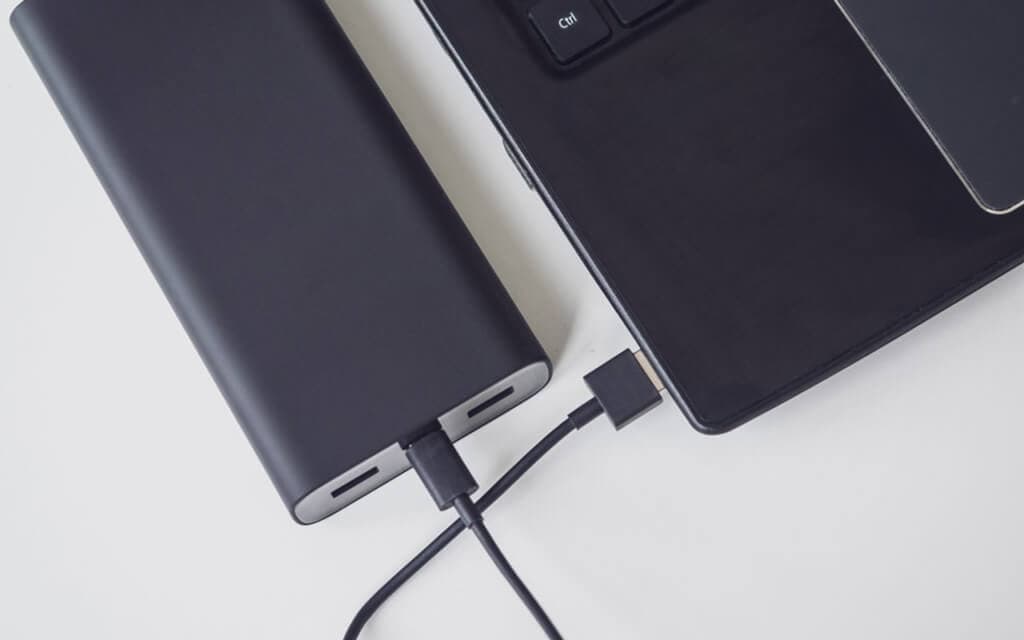
A power bank with USB-C PD output works the same way a wall charger does — it negotiates voltage and current with your laptop. Power banks marketed for laptops generally fall into wattage classes around 65W, 100W, and 140W, and can genuinely recharge a laptop, not just top off a phone.
One practical ceiling if you fly: airline carry-on rules cap spare lithium batteries at 100Wh without airline approval (101-160Wh needs permission, and anything above that is barred), per the FAA's rules on batteries carried by airline passengers. That's why you'll see so many travel power banks specced right at 99.9Wh — it's the largest capacity that clears airport security without extra paperwork.
3. Car and plane charging
A USB-C PD car charger (the kind that plugs into a 12V socket) can charge a laptop the same way a wall charger does, as long as it outputs enough wattage — most compact car PD adapters top out around 30-65W, which is enough for smaller laptops but slow for larger ones. A power inverter plugged into the car's outlet can run your original charger directly, though inverter wattage varies a lot by product, so check the rating against your charger's needs before relying on it.
In the air, some airlines provide in-seat AC or USB power, though policies vary by carrier and cabin class, and increasingly restrict charging external power banks specifically — check with your airline rather than assuming.
4. A proper replacement charger — not a generic "universal" adapter
If your original charger is lost or broken, the safest fix is a real replacement: either the OEM part or a reputable third-party charger rated for your laptop's exact voltage, amperage, and connector tip (or USB-C PD wattage). Avoid cheap no-name "universal" charger kits with a bag of interchangeable barrel tips — these are a common source of voltage and polarity mismatches, and plugging in the wrong tip or voltage can damage your laptop or its battery. If you go this route, match the specs printed on your original charger or your laptop's underside label exactly.
5. External battery chargers (mostly a thing of the past)
If you've read that you can pull the battery out and charge it separately in a dock, that was true of the removable-battery laptops common through the early 2010s — you could pop the battery out and drop it into a standalone external charger. Almost all modern laptops use sealed, internal batteries that aren't user-removable, so this option simply doesn't exist for most machines sold in the last several years. If your laptop still has a removable battery, an OEM external charger may exist for it, but it's now a rare accessory rather than something you can count on finding — check your manufacturer's parts store before assuming one is available.
6. Solar chargers (niche, but real)
Foldable solar panels paired with a USB-C PD power bank can charge a laptop, and they're genuinely useful if you're off-grid for extended periods. Treat published wattage numbers as best-case, direct-sunlight figures — real-world output depends heavily on sun angle, cloud cover, and panel size, so a "100W" panel rarely delivers anything close to that consistently. It's a backup option for camping or remote work, not a primary charging method.
Best way to charge for battery health, not just for a full charge
If your real question is "what's the best way to charge a laptop battery" rather than "how do I charge it without a charger," the answer is less about the power source and more about the habit. Lithium-ion batteries degrade fastest at the very top and very bottom of their charge range — keeping the battery roughly between 20% and 80% instead of habitually running it to 0% or leaving it at 100% for long stretches meaningfully extends its usable life.
Most manufacturers now build a charge-limit feature into their software specifically for this:
- Lenovo Vantage — Battery Charge Threshold, with adjustable start/stop percentages
- Dell Power Manager — "Primarily AC Use" or a custom charge threshold
- HP — Adaptive Battery Optimizer or Battery Care in BIOS
- ASUS — Battery Health Charging in MyASUS
- macOS — a built-in charge-limit option in newer versions
Heat is the other major factor — charging or running a laptop under heavy load while it's hot accelerates wear regardless of charge percentage, so keep vents clear while charging. For more on what shortens battery life day to day, see our guide on how long a laptop battery lasts.
Do not try to charge a laptop battery with bare wires
You may have seen guides suggesting you can charge a laptop battery "manually" by connecting wires directly to its terminals, matching positive to positive and negative to negative. Don't do this.
Lithium-ion cells like the ones in every modern laptop battery need to be charged within a narrow, precise voltage window. Every laptop battery pack normally charges through a Battery Management System (BMS) that regulates voltage, current, and temperature, and stops charging before the cell is pushed past safe limits. Bypass that with a direct wire connection and there's nothing left to stop overcharging, and overcharging a lithium-ion cell can trigger thermal runaway — a self-accelerating heat reaction that can end in fire or an exploding cell. A reversed or mismatched wire connection is just as dangerous, and cover-and-hope workarounds don't remove the risk.
None of the methods above require touching the cell terminals directly, and that's by design — PD chargers, power banks, and proper replacement adapters all negotiate power through the laptop's or battery's own protected charging circuit. If a battery is damaged, swollen, or the laptop won't take a charge through any normal port, the right move is replacement, not rewiring. Our guide on when to replace a laptop battery covers the warning signs.
Frequently asked questions
Can I charge a laptop with my phone charger? Yes, if your laptop charges over USB-C and your phone charger also uses USB-C with Power Delivery. It will likely charge more slowly than your laptop's original charger, since most phone chargers are rated well below what a laptop draws at full power, but it's a safe way to add charge or slow a drain in a pinch.
Can I charge a laptop battery with wires or a jumper-style method? No. Connecting wires directly to a lithium-ion battery's terminals bypasses the battery management system that keeps charging within safe voltage and temperature limits, and can cause overheating, fire, or an exploding cell. There is no safe DIY version of this — use one of the methods above instead.
Can I charge a laptop battery outside the laptop, like on a dock? Rarely, and only if your laptop has an old-style removable battery. Sealed, non-removable batteries — the vast majority of laptops sold today — have no external charging dock option; the battery only charges while installed and connected through the laptop's own charging circuit.
Does charging over USB-C damage the battery? No. USB-C Power Delivery negotiates a safe voltage and current with your laptop before power flows, and the laptop's own charging circuitry still governs how the battery is actually charged. It's one of the safest charging methods available, not a risk to the battery.
The final verdict
For almost every modern laptop, "charging without the charger" really just means finding another USB-C PD source — a phone charger, a power bank, a car adapter — and accepting it might be slower. Gaming laptops are the exception, since many still lean on a barrel connector for full power. Skip any DIY wire-charging method entirely; it bypasses the safety circuitry that keeps a lithium-ion battery from overheating, and the risk isn't worth it when USB-C PD, power banks, and proper replacement chargers cover nearly every real-world situation. If your battery seems to be the actual problem rather than the charger, start with our guides on why your laptop isn't charging and running a laptop without a battery before you replace anything.

Tech enthusiast and founder of Technize. Passionate about making technology accessible and helping people make smarter buying decisions.